

OUR SOLUTIONS
Two Policies to Drive Change.
One Legislative Session.
No new taxes.
Our plan for the 90th Legislature focuses on two interconnected reforms — each tied to a measurable outcome. Each grounded in the data. Funding for specific needs should be attached to specific students and understandable to their parents, the customer. Taxpayers and legislators should be able to trace the flow of funds all the way to the classroom.

POLICY 1
A Study of the Funding Formula
Based on Actual Costs
Texas is proposing significant property tax reforms that will impact school funding.
There is no better time to study alternatives to the current formula that nobody can
fully explain. Funding should be based on the actual cost of services for specific
students in the system, with full transparency.
Create an independent task force of finance, business, education, and policy leaders to oversee the study.
Hire an outside research team without a financial stake in preserving the current Texas formula.
Develop three to five legally compliant, student-centered funding alternatives for legislative evaluation before the 91st Session.
Apply scholarly research on student-centered funding and the highest-performing, most efficient education systems in the United States and around the world.
Test funding expressed in clear dollar amounts, traditional multipliers, and transparent hybrid approaches.
Build on recent Texas education legislative wins by examining how funding can better reflect each student’s documented needs and intensity of services.
Require every alternative to show parents and taxpayers, in plain language, how state, local, and allowable federal resources support students and schools.
Evaluate modern, tamper-evident accounting, including blockchain technology, to improve transparency and prevent waste, fraud, and abuse.

POLICY 2
The Million Word Miracle™
Deep Literacy for Every Texas Student
The Million Word Miracle™ is a structured literacy framework based on what high-performing teachers across the country already do — read high volumes of real literature, including primary source materials. No basal readers. No excerpts in textbooks or on screens. No government-written content replacing works of literary art.
The proposal divides English/Language Arts (ELAR) into two distinct core subjects.

Reading and Literature
- Science-of-reading / phonics-based and structured literacy instruction in K–3, with tiered interventions
- Grades 3–8 read one million words per year of high-quality literature
- Dynamic grouping by reading level, not age or grade — students advance with mastery
- Trade books at or above student reading level, not basal readers, textbooks, or excerpts
- No screen-based reading instruction for K–5 in the classroom
- Standardized reading logs reported alongside test scores
Writing and Public Speaking
- Explicit instruction in handwriting, cursive, grammar, spelling, logic, and structure to mastery in K–6
- Remediation in 7th and 8th grade for any student who has not achieved mastery
- Multi-draft writing process — invention, arrangement, style, developmental feedback, line edits, proofreading
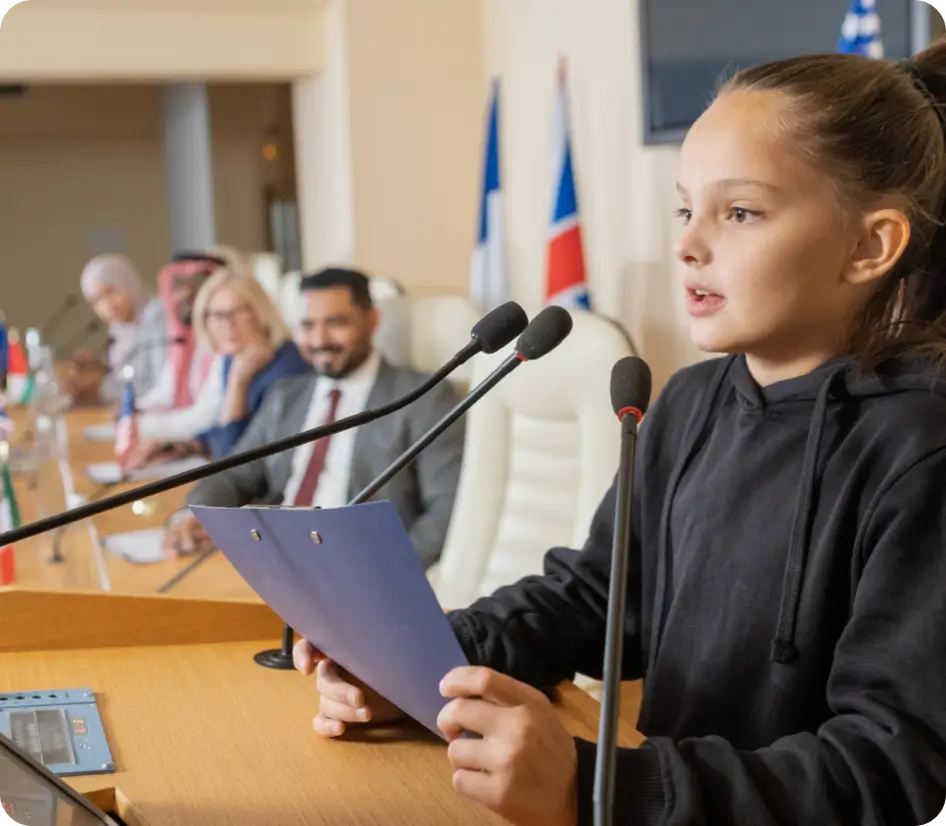
- Public speaking and oral language, including historical speeches and original oratory
- Speech, debate, and forensics may substitute for the writing/speaking class in grades 7–8

Never miss an update.
Join our community and get the big updates as we transform Texas education.